
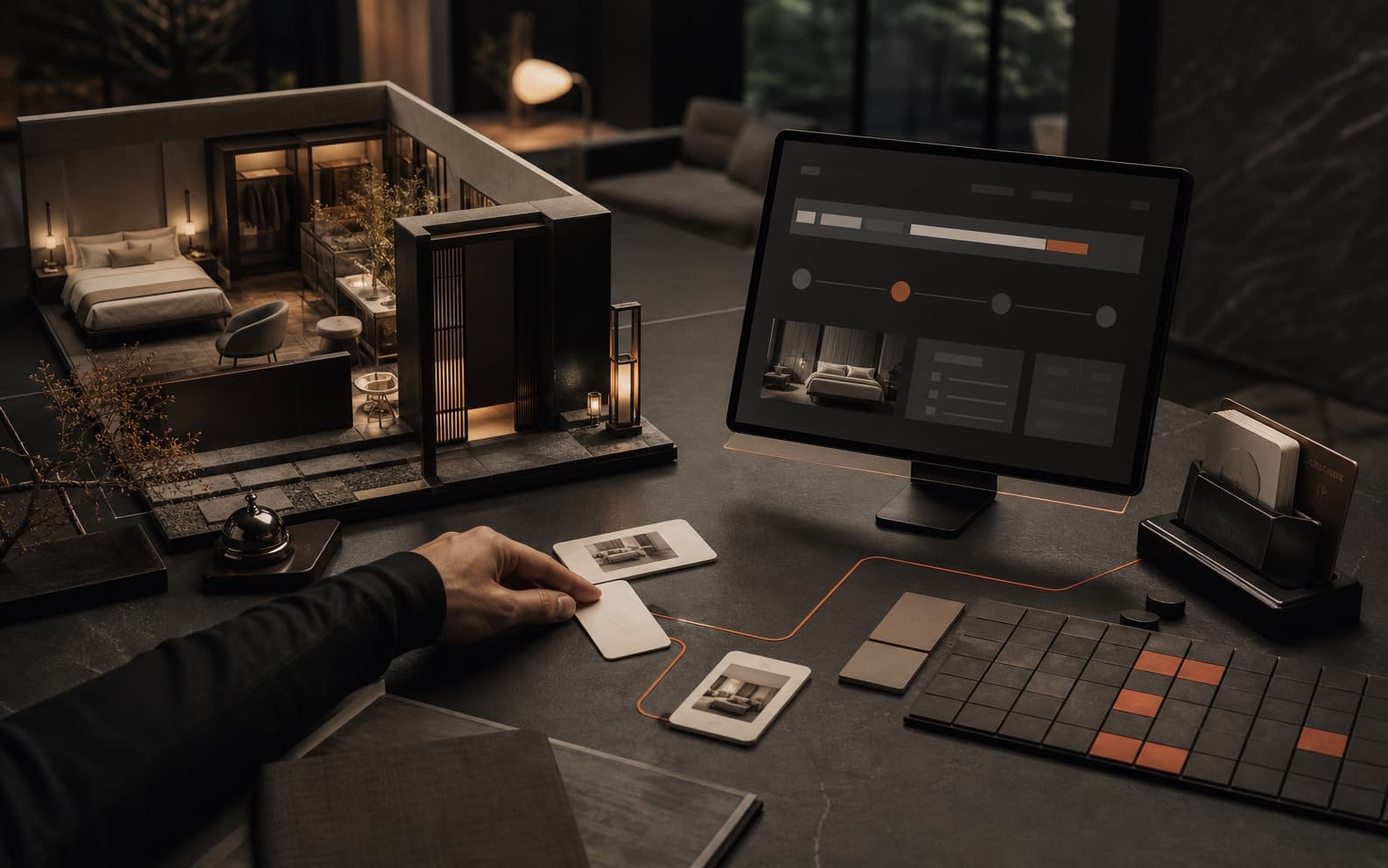
Beauty opens the door; certainty earns the booking
Hospitality is unusually visual. A traveler wants to imagine the light in the room, the atmosphere of breakfast, the route from arrival to check-in, and the feeling of returning at night. Strong art direction matters because the website carries part of the property experience before the guest reaches the property. But visual desire is only the opening condition. The booking still depends on whether the visitor can understand the offer, trust the details, compare the right room, see the real price, and complete the stay without losing confidence.
That is why a hospitality website should be briefed as a service system rather than a digital lookbook. It must connect marketing with inventory, rates, policies, payments, guest communications, analytics, and the operational tools that will honor the promise after confirmation. The decisive question is not whether the homepage feels luxurious. It is whether the whole path from discovery to arrival remains coherent.
A hospitality website earns the booking when the property promise and the operating system tell the same story.
Property content should reduce real uncertainty
Travelers do not need more adjectives; they need usable evidence. A room page should make layout, occupancy, bed configuration, bathroom arrangement, view, accessibility, amenities, inclusions, exclusions, and meaningful differences between room types understandable. Location content should explain arrival and nearby context rather than repeat a destination slogan. Policies should answer the questions that can change a decision: cancellation, deposits, children, pets, parking, check-in, check-out, and any restrictions that affect the stay.
Photography belongs inside that evidence system. Google tells hotel operators that photos are one of the primary ways travelers learn about a property and recommends truthful coverage of rooms, common areas, exterior approaches, and amenities. W3C guidance adds the accessibility requirement: informative images need text alternatives that convey their essential information. The practical editorial rule is simple: show what a guest is choosing, describe what the image proves, and avoid using atmosphere to conceal missing facts.
Direct booking must feel like one continuous path
A direct-booking call to action is not useful if it drops the traveler into an unrelated interface with different language, styling, room names, or prices. The transition should preserve the selected property, dates, occupancy, room, rate, currency, language, and campaign context wherever the booking engine permits. Google’s guidance for free booking links says the landing page should make the selected room and rate easy to locate and should remain functional and reasonably fast. Its hotel landing-page documentation also treats country, currency, language, and device as matching criteria. These are not edge cases; they are part of carrying a person’s decision forward without making them begin again.
The website should therefore be tested as a sequence, not a collection of screens. Start from a destination search, a property result, a room page, an offer page, and a mobile return visit. Follow each path through dates, occupancy, rate conditions, add-ons, guest details, payment, confirmation, and the first post-booking message. Every unexplained reset, contradictory label, dead end, or surprise charge asks the traveler to re-evaluate trust.
Trust signals must be specific enough to verify
Trust is not a strip of generic badges. It is the accumulation of details that agree: current contact information, a recognizable address, accurate room descriptions, clear policies, realistic photography, consistent rates, visible payment handling, and a confirmation that says exactly what has been reserved. Google’s hotel guidance emphasizes keeping property details, rates, availability, and landing-page prices current and aligned. That consistency is stronger than any decorative claim about being the best choice.
Price presentation is a particularly important test. The UK Competition and Markets Authority says total prices should be clear, complete, accurate, and include mandatory charges rather than revealing them late through drip pricing. Its accommodation-booking principles also warn against misleading scarcity messages and false discount comparisons. Laws differ by market, so operators need local legal advice, but the design principle travels well: show the traveler what they will pay, what is included, what can change, and what conditions attach to the rate before commitment.
The booking form is part of the guest experience
Once a traveler is ready, the interface should become calmer. Ask only for information the reservation and lawful follow-up require. Use persistent field labels, explain formats and conditions, keep error messages close to the problem, preserve entered data after validation, and make keyboard and mobile interaction predictable. W3C’s forms guidance recommends labels that identify the purpose of controls and are correctly associated with them so browsers and assistive technologies can present the form accurately.
Payment architecture deserves the same care. PCI Security Standards Council guidance for e-commerce addresses controls for scripts that can affect payment pages, including authorization, integrity, and tamper monitoring under PCI DSS v4.x. A hotel does not need to turn the guest-facing site into a security manual, but its team must know which provider owns payment processing, which scripts can run in the checkout context, how the chosen integration affects compliance scope, and where a guest can obtain help when payment fails. Security is operational work, not visual reassurance.
Search connects property content to live inventory
Hospitality search has two connected layers. The first is the property story: useful pages that answer real questions about rooms, amenities, location, policies, experiences, and suitability. Google’s people-first content guidance recommends original, substantial information created for an intended audience rather than pages assembled mainly to attract search visits. For a hotel, that means publishing knowledge that only the property can explain clearly, not producing interchangeable destination copy.
The second layer is commercial availability. Google’s free booking links can send travelers from Search and Maps to a hotel’s own booking site, while Hotel Center integrations depend on current property data, prices, availability, landing pages, and room metadata. Google explicitly says rate freshness and price accuracy are important and that a mismatch between search and the booking site can confuse users and lose bookings. Search strategy is therefore not complete when a page ranks. It is complete when discoverable content, accurate property data, and a valid bookable offer meet on the same journey.
Every integration needs an owner and a failure plan
The visible site usually sits above several systems: a content platform, booking engine, property-management system, channel manager, payment provider, customer or guest record, analytics, consent tooling, messaging, and sometimes loyalty or revenue-management services. Connecting them is not the strategy. The strategy is deciding which system owns each fact, how quickly changes propagate, what identifiers are shared, what consent travels with data, and what the team does when synchronization fails.
For rates and inventory, a useful contract names the source of truth, update cadence, supported room and rate combinations, taxes and fees, cancellation rules, currency behavior, oversell controls, and alert path. Google’s hotel integration documentation shows why this discipline matters: pricing and availability data change frequently, landing URLs must remain current, and room or package metadata must be maintained. Even when an integration partner handles the feed, the property still needs an accountable person who can recognize a stale rate, broken deep link, or room mismatch before the guest does.
Measure the whole service, not the prettiest page
A hospitality website should be evaluated through the decisions it supports. Useful questions include: Can travelers distinguish room types? Do landing-page rates match the booking flow? Where do mobile users restart? Which policies generate support contacts? Are direct-booking sources tagged correctly? Do failed payments and abandoned reservations reach an owner? Are confirmation messages and pre-arrival communications consistent with the booking record? These questions connect analytics with operational observation instead of reducing performance to homepage traffic.
The best redesign brief will therefore cross departmental boundaries. Marketing can own the property story, but reservations understands questions and abandonment; revenue teams understand rates and restrictions; operations knows which promises are difficult to fulfill; finance and security understand payment; and technology understands integration behavior. Beauty still matters. In hospitality, it can express the quality and character of a stay with unusual power. It becomes commercially useful when every system behind it helps the guest believe the same promise, then deliver it.
References
- About hotel free booking linksGoogle Hotel Center Help · Accessed 2026-07-21
- Best practices for free booking linksGoogle Hotel Center Help · Accessed 2026-07-21
- Pricing overviewGoogle for Developers: Hotel Prices · Accessed 2026-07-21
- Integration OverviewGoogle for Developers: Hotel Prices · Accessed 2026-07-21
- Photo recommendations and best practicesGoogle Hotel Center Help · Accessed 2026-07-21
- Creating Helpful, Reliable, People-First ContentGoogle Search Central · Accessed 2026-07-21
- Images TutorialWorld Wide Web Consortium (W3C) Web Accessibility Initiative · Accessed 2026-07-21
- Labeling ControlsWorld Wide Web Consortium (W3C) Web Accessibility Initiative · Accessed 2026-07-21
- Providing clear and accurate information about prices: summaryUK Competition and Markets Authority · Accessed 2026-07-21
- Being transparent with your customers: a short guide for online accommodation booking sitesUK Competition and Markets Authority · Accessed 2026-07-21
- New Information Supplement: Payment Page Security and Preventing E-SkimmingPCI Security Standards Council · Accessed 2026-07-21
More perspectives from E2W.Join the list