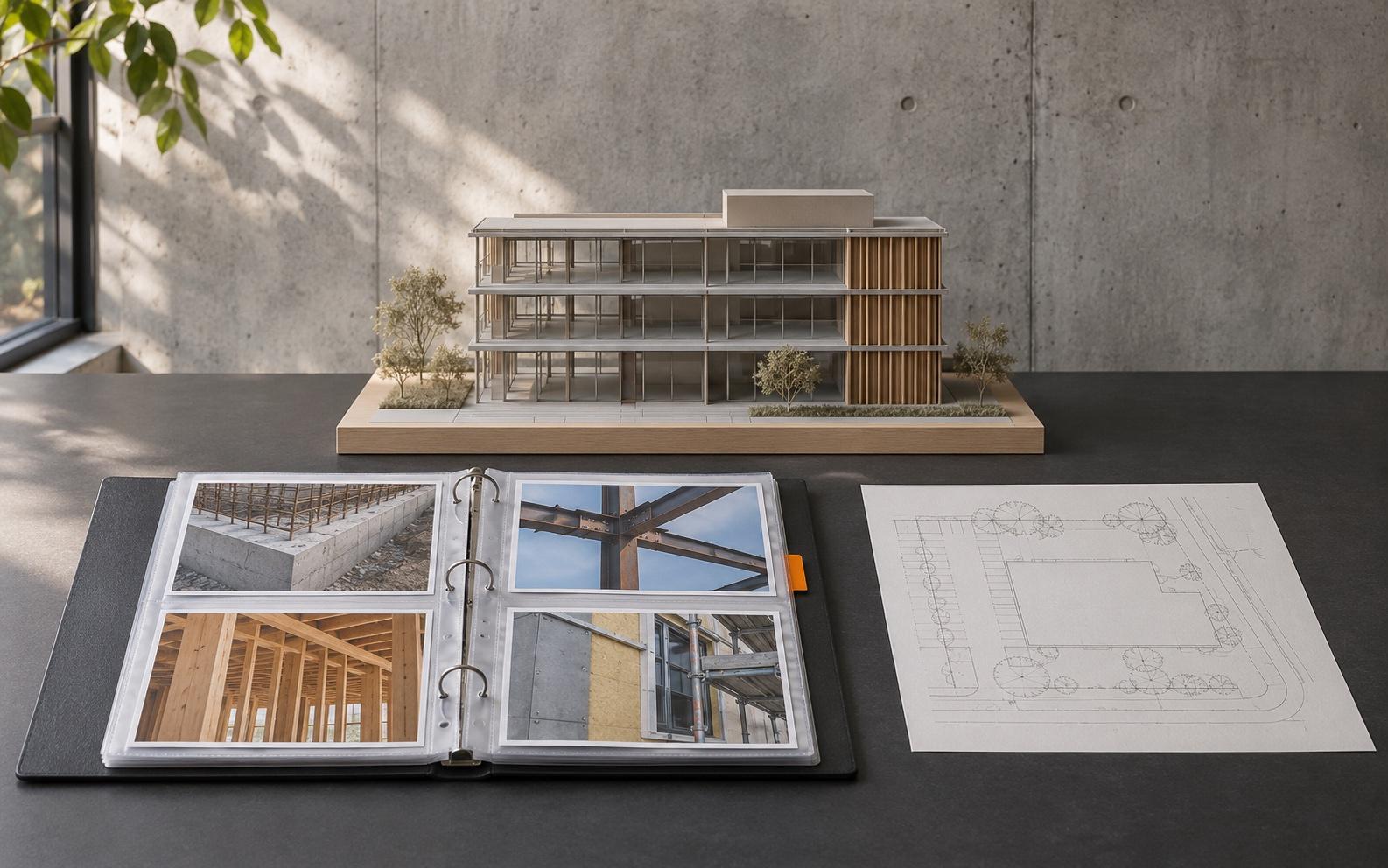
A camera roll is not yet a construction record
Site teams take photographs for many valid reasons: existing condition, progress, concealed work, an inspection, a test, a defect, a delivery, a change, an instruction, a safety observation, a payment assessment, a handover record, or a later maintenance question. The same image may eventually be reviewed by people who were not present and who do not share the photographer's memory. If the file arrives as one of hundreds of similarly named images, its visible content alone may not establish where it belongs, when the condition existed, what requirement was being checked, or whether the matter was accepted or corrected.
ISO 19650-1 describes built-asset information management as a lifecycle activity that includes exchanging, recording, versioning, and organizing information for multiple actors [1]. Photographs sit inside that wider information environment. The useful unit is therefore not only the pixel file. It is the image plus enough structured context, relationships, controls, and ownership to make the record understandable and retrievable later.
A construction photograph becomes evidence when the project can recover its purpose, place, time, source, related record, decision, and owner.
Decide what the photograph is meant to prove
A broad instruction to take progress photographs creates volume without necessarily creating evidence. Define the trigger and question first. Is the image recording a baseline before work starts, the sequence before concealment, conformity with an approved detail, a failed inspection, the extent of damage, the result of remediation, or general progress at a reporting date? The purpose determines the viewpoint, scale, sequence, companion information, reviewer, and required quality.
Official construction requirements illustrate the difference. A GSA contract requires project photographs to identify what and where they show, carry the date, depict technical work in progress, and enter the project record [2]. A USACE specification organizes photographs by month, relates file names to a view-location sketch, includes a date designator, and cross-references the relevant daily report [3]. These are contract-specific examples, not universal rules; they show why a photo brief should state the later decision or evidence need before capture begins.
Make location and orientation recoverable
A close-up of reinforcement, a firestop, a membrane lap, a cable penetration, or a damaged finish may be visually clear yet impossible to place. Record the project, asset or building, level, zone, room or grid, element, and viewing direction at the level of precision the later decision requires. Link the image to a marked plan, model location, inspection point, asset identifier, or work package rather than asking a future reviewer to infer location from background clues.
Location should be specific without exposing unnecessary sensitive information. The UK Planning Inspectorate's application guidance expects photographs to be labelled, annotated, dated, and located on a map or plan in its defined submission context [6]. For repeatable records, establish the location vocabulary at project setup and use controlled values where practical. Free-text variants such as 'north core', 'core north', and 'NC' may describe the same place but weaken retrieval.
Preserve capture time, source, and file integrity
Record when the condition was captured, who or which organization created it, and which device or controlled application produced the file when that matters. Distinguish capture time from upload, edit, export, and report dates. Preserve the original file where contractual, regulatory, evidential, or technical needs justify it; create an identified derivative for annotation or redaction rather than silently overwriting the source.
NARA's digital-photograph guidance calls for unique identification, captions covering who, what, when, where, and why, photographer information, rights restrictions, technical metadata, logical arrangement, and quality-control information for the records within its scope [4]. UK Ministry of Defence records guidance similarly emphasizes creating accurate descriptive metadata at source, recording the date the imagery was taken, retaining the original file name, and identifying the creator or responsible organization [5]. Project teams should translate those records-management principles proportionately, not claim archival compliance by copying isolated fields.
Use a sequence when one frame cannot carry the context
Critical work often needs a set: an establishing view that locates the subject, a medium view that shows interfaces, and a close view that shows the condition or measurement. Before-and-after pairs should use a repeatable viewpoint where possible. Concealed work may need planned stages tied to inspection or hold points. A photograph of the final surface cannot prove the continuity of the layer behind it, while a close-up of the concealed layer may not prove where it was installed.
USACE guidance for construction foundation records requires captions with project, date, feature, and camera location, or an indexed map showing camera position and direction [7]. UK government research into volumetric construction also identified time-stamped photographic evidence across manufacture, transit, installation, and completion as a possible audit trail within a wider quality-assurance process [8]. A sequence gains meaning from its relationship to the approved requirement, inspection, test, issue, or decision—not merely from chronological order.
Design privacy, security, and rights into capture
Construction photographs can reveal workers, visitors, vehicle registrations, neighbouring property, personal information on boards, access routes, keys, security systems, plant controls, serial numbers, hazardous conditions, client operations, or commercially sensitive details. Define where photography is prohibited or controlled, who may capture and upload, whether identifiable people should be excluded, when consent or another lawful basis is required, which images need review or redaction, and who may receive the record.
The Planning Inspectorate says identifiable people should not appear in the photographs used for its application process without consent [6]. ICO surveillance guidance uses a construction-site example to stress transparency and accountability where people are recorded, while noting that monitoring obligations depend on context and applicable data-protection law [9]. UK government security guidance requires information creators to assess sensitivity, need-to-know, handling, and the consequences of compromise [10]. These sources apply to defined UK contexts; each project must follow its own jurisdictions, contracts, client rules, security plan, and qualified advice.
Plan retention and retrieval before the archive grows
Not every image needs the same retention. A disposable coordination snapshot, a contractual progress record, evidence of concealed life-safety work, a defect history, and an asset-maintenance photograph may have different owners, access rules, retention triggers, and disposal requirements. Define the authoritative repository, naming or identifier scheme, minimum metadata, version and derivative rules, backup, export, legal hold where applicable, and disposition authority before records scatter across phones, messaging channels, email, reports, and several project platforms.
Test retrieval using realistic later questions: show every accepted firestop photograph for this riser; find the membrane condition before the terrace finish; reconstruct the evidence reviewed when this issue closed; identify images containing a person for an access request; export the asset's handover photographs with captions and rights information. If the system can store images but cannot answer the anticipated question, the record design is incomplete.
Use the E2W eleven-field construction-photo evidence envelope
For every photograph or controlled set, record eleven connected fields. **Purpose** states the question or evidence need. **Location** identifies project, space, element, and viewpoint. **Time** distinguishes capture from upload, edit, review, and decision. **Source** identifies creator, organization, device or application where relevant, and original file. **Subject** describes what is visible and the significant condition. **Related record** links the applicable drawing, requirement, issue, inspection, test, instruction, report, or asset. **Status** records submitted, reviewed, accepted for purpose, rejected, superseded, corrected, or closed. **Access** defines privacy, security, rights, permitted users, and disclosure controls. **Retention** states the authoritative repository, required life, hold, export, and disposition. **Decision** records who concluded what, on which evidence, with which limits and resulting action. **Owner** assigns capture quality, review, metadata, repository, access, retention, and later response.
Apply the envelope proportionately. A routine progress image may use project defaults for several fields; a concealed fire-safety interface, structural repair, contamination record, neighbour condition survey, payment dispute, security-sensitive installation, or handover asset may need explicit values and stronger controls. This is original E2W editorial guidance, not a contractual clause, records schedule, evidential guarantee, privacy assessment, security classification, quality certification, or substitute for competent project-specific advice.
Ask these questions before the next image is taken
What later question must this image help answer? Does it need an establishing, interface, and detail view? Can another person locate the subject without guessing? Which approved requirement or project record gives the image meaning? Is the original preserved, and are annotations or redactions identified as derivatives? Who has authority to review the condition, and how will the result change the linked issue or inspection status?
Could the frame expose a person, neighbouring property, security detail, confidential operation, or data that should not leave the site? How long must the record remain, who owns it, and can the repository retrieve it by location, subject, status, decision, and retention rule? These questions connect [better project documentation](/insights/the-quiet-value-of-better-project-documentation), [less fragmented AEC data](/insights/how-project-data-becomes-fragmented-across-aec-tools), [buildable construction information](/insights/what-makes-a-construction-drawing-buildable), and E2W's [web and software service](/services/web-software). Good photo records are designed for the future person who needs evidence, not only the present person holding the camera.
References / 10
- 01ISO 19650-1:2018 — Information management using building information modelling — Concepts and principles International Organization for Standardization · Accessed 2026-11-13
- 02GSA Leasing Support Services Plus: Contract Sections B–J U.S. General Services Administration · Accessed 2026-11-13
- 03Japan Edited Specifications, Section 01 11 00.00 10 U.S. Army Corps of Engineers, Japan Engineer District · Accessed 2026-11-13
- 04Digital Photographic Records U.S. National Archives and Records Administration · Accessed 2026-11-13
- 05Records management policy UK Ministry of Defence · Accessed 2026-11-13
- 06Nationally Significant Infrastructure Projects: Advice on the Preparation and Submission of Application Documents UK Planning Inspectorate · Accessed 2026-11-13
- 07Construction Control for Earth and Rock-Fill Dams, EM 1110-2-1911 U.S. Army Corps of Engineers · Accessed 2026-11-13
- 08Volumetric Modular Construction Research UK Department for Levelling Up, Housing and Communities · Accessed 2026-11-13
- 09How can we comply with the data protection principles when using surveillance systems? Information Commissioner's Office · Accessed 2026-11-13
- 10Guidance 1.1 — Working at OFFICIAL UK Cabinet Office · Accessed 2026-11-13
MORE FROM THE E2W JOURNALKeep the conversation going.Join the list